
Choosing the right kindergarten for your child is no child’s play! The choice that you make for your child today will influence their overall development, understanding, and most importantly, their future.
If you have been exploring Docklands kindergarten options, you may have come across the term ‘play-based learning’. So, what does it mean? Does it really help a child learn better, gain knowledge, and develop real-world skills in a better way? If you have been grappling with all these questions, you have arrived at the right place. Read on to learn why play-based learning in kindergarten is the right choice for your child.
Play-Based Learning Works Beyond Toys
Play-based learning is a method where children learn through activities they choose and enjoy. At the same time, educators guide those moments towards clear Early Years Learning Framework (EYLF) outcomes, which encompass belonging, being, and becoming. In this type of learning, children engage in hands-on activities such as building, sorting, pretending, drawing, singing, and outdoor exploration. Educators don’t step back; they observe, document learning, and extend it. A well-timed question, such as “What happens if we try a different shape?”, links a child’s interest to language, early maths, or scientific thinking without turning play into a lesson.
The Four Elements of a Planned Environment
Below are the four key parts of a planned environment that can help a child develop holistically:
1. Physical Environment
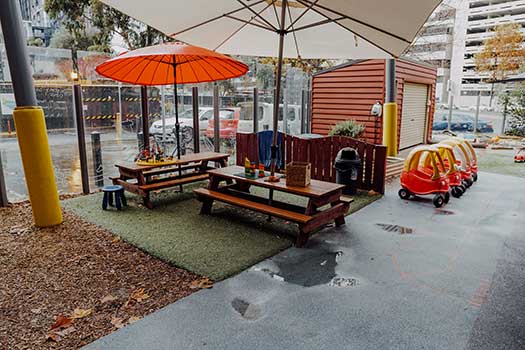
The layout, furniture, and materials are arranged to invite exploration and enquiry. There are accessible shelves, varied textures, quiet nooks, and space to move.
2. Social and Emotional Environment
In such an environment, relationships feel secure, warm, and trusting. Educators support turn-taking, friendships, and self-regulation and set the necessary emotional tone with children.
3. Intellectual Environment
Educators balance free play with “shared sustained conversations” (an EYLF-aligned practice) that stretch thinking. Such an environment fosters open questions, new vocabulary and connections to children’s interests.
4. Temporal Environment
Children get large blocks of time to develop play themes rather than being rushed between activities.
What Children Learn Through Play
Through play-based learning, children experience steady gains that help them thrive in the real world. They are as follows:
- Social Learning: Children learn to make connections, negotiate, and contribute to group play.
- Improved Communication: The language skills and vocabulary significantly improve through songs, stories, and pretend play.
- Thinking Skills: Children get comfortable with problem-solving, experimenting, and noticing patterns and sequences.
- Enhanced Wellbeing: They develop the necessary confidence to try new things, manage feelings better, and persist through challenging situations.
How to Support Play-Based Learning at Home
While you choose play-based learning at kindergarten for your child, it is essential to establish a similar healthy learning environment at home. Doing so will help the child develop holistically. Here are a few easy ways to ensure that your child plays and learns at home.
- For a steady environment, keep it simple and connected to what you see at the centre.
- Follow what your child enjoys, such as trains, shells, or colours, and talk to them as you play.
- Offer open-ended materials such as blocks, boxes, pencils, and playdough rather than single-use toys.
- Ensure you share your observations with educators to help shape meaningful learning plans.
Final Thoughts
A strong play-based program is easy to recognise. This is where children choose and concentrate; educators listen, extend, and document; families are partners; and the overall environment is thoughtfully designed. At Kids & Co Early Learning Centre in Docklands, you will find all these aspects meticulously cared for.
Choosing a kindergarten is about selecting the environment that best supports your child’s learning and development as a person. In a play-based learning environment, your child can thrive without any undue pressure or expectations. For more information or to address any concerns, feel free to contact the Kids & Co Early Learning Centre team or visit us in person.
